|
Adapting Aspirational Modernism: The 1939 World’s Fair Belgian Friendship Building and Expo 67’s Habitat
Tuesday, June 9, 2026
2:00 p.m. - 3:30 p.m. ET
As showcases for invention and innovation, world fairs have presented unique creative opportunities for bold engineering and iconic architecture symbolizing progress. While many fair structures were never intended to survive beyond an exposition, vestiges remain and continue to evolve as enduring expressions of cultural pride and optimism. This webinar will explore the history, reuse and conservation of two geographically distant world’s fair icons conceived in very different times, places and socio-political environments, resulting in unexpectedly differing outcomes.
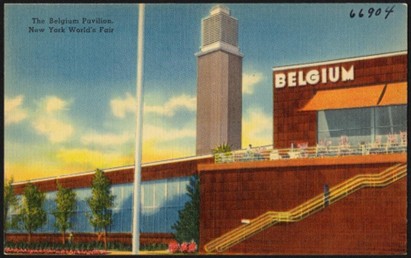
Belgian Friendship Building
The Belgian Building at Virginia Union University, the sole surviving structure from the 1939 New York World's Fair, presents two distinct preservation conditions rooted in its original design as a temporary exhibition pavilion. Its structural steel frame — built-up riveted columns and girders connected between assemblies with bolts, allowing rapid disassembly — has performed with exceptional durability, showing no measurable movement or significant corrosion after more than eighty years. The envelope system is another matter. Architectural terra cotta tiles, stamped "Pottelberg, Made in Belgium," are suspended from horizontal steel purlins by galvanized wire and held in place with mortar whose thermal expansion coefficient is incompatible with both the steel and the tile. Differential movement has cracked and displaced mortar throughout, leaving the purlin system exposed to water infiltration. The wall assembly offers no practical path to remediation: the uninsulated air gap resists insulation, the thin steel window frames cannot accept double-pane glazing, and interior furring would damage original soapstone sills throughout. Available interventions threaten harm to what remains, fail to address the underlying condition, or conceal character-defining features of the building — a consequence of a system designed for a two-season exhibition, now asked to perform indefinitely in the humid mid-Atlantic climate of Richmond, Virginia.
Bryan Clark Green, coauthor of The Robert L. Vann Tower and the Belgian Friendship Building, published in 2025, will chronicle this strange saga, the building’s international journey, its preservation, adaptation and many lives.
Habitat 67
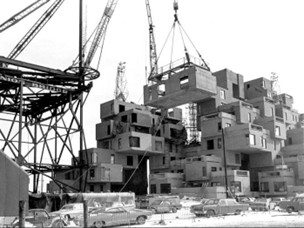
When it was designed and built half a century ago by the young and promising architect Moshe Safdie, Habitat 67 reflected the most unconventional aspects of the Montreal landscape. Its prefabricated, modular concrete construction, stacked in an unusual and irregular configuration, was shocking. Safdie's concept behind Habitat 67's bold form aimed to introduce a cutting-edge housing option—a hybrid between the multilevel single-family home and the multi-apartment urban building. Over the years, it has attracted tourists and architecture enthusiasts from around the world to study its fascinating composition.
Habitat was designated a heritage building (historic monument) by the Quebec Ministry of Culture in 2009 to preserve its iconic facade and fundamental character. When Moshe Safdie decided to renovate and restore his own unit within the Habitat complex, his vision was to preserve its character-defining attributes while making significant improvements. Architect Ghislain Bélanger of CO12 Architects worked closely with Safdie to address decades of water damage and restore the interior while undertaking technical upgrades to meet 21st century sustainability and energy conservation standards. Safdie and CO12 architects continue to be involved in the ongoing restoration of the building’s concrete exterior.
Learning Objectives:
- Understand the history and historic significance of the Belgian Friendship Building structure from the 1939 New York World's Fair and the Habitat 76 from Canada Expo 67 centennial celebration.
- Identify character-defining attributes of early to mid-century modernist buildings
- Distinguish the building's primary construction technologies and evaluate why each has performed differently over time.
- Evaluate the limitations of standard preservation repair strategies, including unit replacement, cavity insulation, and interior remediation, when applied to an integrated enclosure system never designed for long-term maintenance.
- Apply a framework for distinguishing buildings that resist preservation intervention because of formal design discipline from those that resist it because of designed impermanence, and consider the implications of that distinction for preservation practice more broadly.
Continuing Education Credits
1.5 LU/HSW/PDH (pending)
Accreditation guidelines dictate that CEU credit is only available to participants of the live program.
Can't join the webinar live? A limited-access recording of this session will be available exclusively to those who register for the webinar. Please note, per AIA guidelines, only participants of the live program are eligible for continuing education credits.
Registration Fees
- APT Members: $20
- Emerging Professional Members: $15 $0*
- Student Members: $10 $0*
- Non-Members: $35
* Thanks to the generous support of the Preservation Fund of the National Trust for Historic Preservation, APT is pleased to offer this program at no cost to Student members and Emerging Professional members. Not a member? Learn how to join here.
Speakers:
 |
Ghislain Bélanger, MOAQ, MRAIC, PA LEED
Ghislain Bélanger is an educator, architect, and founder and principal of CO12 Architecture, a firm dedicated to the integration of the social, material, and environmental dimensions of architecture into design through continuous research and development. With over 28 years of experience, Belanger’s expertise extends to education, culture, healthcare, and specialized housing. CO12 Architecture's current practice focuses on the preservation of modern heritage, design for northern environments, and the design and rehabilitation of senior care facilities.
|
|
 |
Bryan Clark Green, PhD.
Bryan Clark Green is Visiting Associate Professor of Practice in the School of Architecture at Virginia Tech and principal of the Center for Architectural History and the Built Environment / Studio for Architectural History and the Built Environment in Richmond, Virginia. An architectural historian and preservation practitioner, he is the author or coauthor of four published books, including (with Kathleen James-Chakraborty and Katherine Kuenzli) The Belgian Friendship Building: From the New York World's Fair to a Virginia HBCU (University of Virginia Press, 2025), In Jefferson's Shadow: The Architecture of Thomas R. Blackburn (Princeton Architectural Press, 2006), Building a President's House: Newly Discovered Architectural Plans for James Madison's Montpelier (The Montpelier Foundation, 2007); and Lost Virginia: Vanished Architecture of the Old Dominion (Howell Press, for the Virginia Historical Society, 2001)with six additional books under contract through 2028 on subjects ranging from Barboursville in Orange County, Virginia and Union Station in Richmond to the removal of Confederate monuments and the preservation of postmodern buildings.
Before joining the Virginia Tech faculty, Green spent seventeen years as Director of Historic Preservation at Commonwealth Architects in Richmond, one of Virginia's leading architecture firms. His practice encompasses historic structures reports, conservation and rehabilitation studies, restoration projects, preservation planning, and historic tax credit certifications across Virginia and the Mid-Atlantic. He served as Secretary of the Society of Architectural Historians, having chaired the society's Heritage Conservation Committee for a decade, and as Co-President of the Center for Palladian Studies in America. He serves as co-chair of APT’s Training and Education Committee and served on the board of the Association for Preservation Technology International from 2021 to 2024 and as Virginia's representative to the National Capital Planning Commission from 2022 to 2025, a presidential appointment.
His work has been recognized by research fellowships at the International Center for Jefferson Studies at Monticello, the Winterthur Museum, Garden, and Library, and the Virginia Historical Society, and by the Presidential Citation from the Association for Preservation Technology International (2022). He received the Certificate for Excellence in Outreach and Engagement from the College of Architecture, Arts, and Design at Virginia Tech in 2025, the College's highest award for public service.
|
|
 |
This project has been funded in part by a grant from the National Trust Preservation Fund of the National Trust for Historic Preservation. Specifically, in support of growing participation of students and emerging professionals in online programs. |
|